Disclaimers
I'm trying to cold-start my heart and mind. I asked on socials for people to ask me questions about Mark Z. Danielewski's books. I keep wanting to write about them, but it feels too big for the tiny energy I have available.
I've been thinking about them for about 25 years. I've re-read all of them many times, discovering new things all the time. I love making connections, and speculating. I don't purport to be Correct, just to be Interested. :)
So, if you want, you can ask me questions! I'd love to be asked "What's happening on page X of Only Revolutions?"
I posted that to socials earlier, and Sarah asked why they're my super special interest. BIG QUESTION OKAY LET'S TRY!
Why these books?
It's a big question! This is all personal, like all opinions, in case you forgot! I feel the need to couch my enthusiasm, because I've been kicked around too many times by people who, frankly, have not understood me! I can definitely be wrong. It happens all the time. But I think really, really hard about things.
Let's start there. I read House of Leaves for the first time in early winter. I was 16. I have never, ever stopped thinking about it for more than a few days at a time. As Mark released further books, I was perplexed by each, thrilled by their artistry, and then activated by making connections between everything that had been released so far.
But first: they are absolutely crackling stories. I go to how much fun they are to think about, but first: they are very, very fun to read! And they aren't like anything else you've ever read, in very exciting ways! And I mean that; there are no other books written in English that match these for sheer depth of consideration and multilayered interpretation. Believe me: I've looked!
Kaleidoscopic Text
Everything Mark has published, from his first short fiction to last October's Tom's Crossing, is part of an interconnected web. Not a "narrative" web, not exactly; this is not a Cinematic Universe (......?) so much as... a web of concepts. Of colors and shapes. Of various attempts to reckon with what, exactly, we are as creatures who can engage in complex, abstract thought. Often to our detriment. But thinking can be such a beautiful thing, if you can escape the endless array of traps along the path.
I recognized these interconnections as soon as I had read both HoL and Only Revolutions. I don't know how a person decides to do this, or exactly how he has pulled it off. But he has, exquisitely, while also telling deeply-felt stories.
I have described them as "chew toys for your mind." I have said they are "meditative wounds," a concept I would like to expand on in the future. I've said they're places for the connective mind to roll around, and to channel instincts that might lead to conspiratorial thinking toward something more productive.
I have re-read House of Leaves somewhere between 15 and 20 times. Not always in its entirety; but at least a dozen times cover-to-cover. Every single time, from the first to the most recent, I have seen things I didn't see the previous times. Like... truly. Things that I read and interpreted one way, and then read again later and see that they also contain other meanings.
Not that I've "solved" them, or "discovered the truth." There are definitely things that become clearer; and many things I'd say are still hazy or questionable to me. But I've almost never thought, "Oh, I TOTALLY misread that. Now I 'get it.'" Instead it's the incredible feeling of having different things in my head when I encounter the text; and the text being so beautifully embroidered that new details snap together and talk to each other.
What are the stories, then?
I'll give the short pitch, and then go a little further.
House of Leaves
A family moves into a house, then return from a weekend away to find a new, dark hallway between two rooms. Then another. Then a hallway that leads "outside" the house, without physically appearing outside. As they investigate and explore the ever-growing warren of empty darkness, their relationships are tested, forged or broken. Can a curious mind handle a terrain devoid of apparent meaning?
Now we get to the part that I think is either intriguing or off-putting to people. This is one of several stories, or perspectives, in the book. The intro is actually written by a ratty little dropout in LA named Johnny. His elderly neighbor just died; his friend convinces him to break in, where they find a massive trunk full of writing. Johnny takes the trunk, and start piecing the contents together. They're (mostly) an academic-style treatise on the story of the family and the house. Johnny reads and responds to the text as we're reading it, too.
I find this can be a breaking point for lots of people. For several reasons. First, they assume it's a gimmick; that simply doing something unusual with formatting cannot be meaningful. I have to stress that I do get the impulse; I've read lots of things that have disappointed me with an interesting premise that doesn't pay off! But this absolutely pays off.
Second, as the page layouts get more unusual, or a section doesn't make immediate sense, people tell me they either feel stupid, or worry they're not "smart" enough to "get it." I try to encourage people to just sit with that discomfort, and keep your eyes moving across the pages. If you get lost, you'll be found again soon.
Third, not everybody loves Johnny's character. They just want the house, don't like that Johnny is a troubled young person, who can be bratty and crude and depressed. They don't like that he talks about sex a few times in ways they can't relate to. I have never been put off by any of that; I think it's interesting! Because the other thing about Johnny is... he's not always saying what you think he is. Nor even what he thinks he is. Not in a standard-issue "unreliable narrator" way; the book is better than that. I don't think I can try to explain that further right now, even though I really want to!
Anyway, House of Leaves is a big, scary book about a big, scary house, and the fear of not being able to understand. It produces the effect it is about.
And then... there are the other reasons I've read it so many times.
Also, house is always in blue. Yeah, it actually has a bunch of cool reasons for doing so.
Here's an arbitrarily-chosen passage, flipped open to page 82. This isn't "the best" part of the book, but I think it's a decent little cliffhanger:
On the day Holloway and his team arrive at Ash Tree Lane, Navidson and Tom are there to greet them at the door. Karen says a brief hello and leaves to pick up the children from school. Reston makes the necessary introductions and then after everyone has gathered in the living room, Navidson begins to explain what he knows about the hallway.
He shows them a map he drew based on his first visit. Tellingly, this hardly strikes Tom as news. While Navidson does his best to impress upon everyone the dangers posed by the tremendous size of that place as well as the need to record in detail every part of the exploration, Tom passes out xerox copies of his brother's diagram.
Jed finds it difficult to stop smiling while Wax finds it difficult to stop laughing. Holloway keeps throwing glances at Reston. In spite of the tape he saw, Holloway seems convinced that Navidson has more than a few loose wing nuts jangling around in his cerebral cortex. But when the four dead bolts are at last unlocked and the hallway door drawn open, the icy darkness instantly slaughters every smile and glance.
Newt Kuellster suspects the first view of that place irreparably altered something in Holloway: "His face loses color, something even close to panic suffuses his system. Suddenly he sees what fortune has plopped on his plate and how famous and rich it could make him, and he wants it. He wants all of it, immediately, no matter the cost."88 Studying Holloway's reaction, it is almost impossible to deny how serious he gets staring down the hallway. "How far back does it go?" he finally asks.
"You're about to find out," Navidson says, sizing up the man, a half-smile on his lips. "Just be careful of the shifts."
88See Newt Kuellster's "The Five and a Half Minute Holloway" in the The Holloway Question (San Francisco: Metalambino Inc., 1996), p. 532; as well as Tiffany Balter's "Gone Away" in People, v. 43, May 15, 1995, p. 89.
And one of my favorite moments, which has colored so much of how I've read all of Mark's work, from page 75:
Suddenly, somewhere in the house, there is is a loud yowl and bark. An instant later Mallory comes screaming into the living room with Hillary nipping at his tail. It is not the first time they have involved themselves in such a routine. The only exception is that on this occasion, after dashing, after dashing up and over the sofa, both puppy and cat head straight down the hallway and disappear into the darkness. Navidson probably would have gone in after them had he not instantly heard barks outside followed by Karen's shouts accusing him of letting the animals out when on that day they were supposed to stay in.
"What the hell?" we hear Navidson mutter loudly.
Sure enough Hillary and Mallory are in the backyard. Mallory up a tree. Hillary howling grandly over his achievement.
For something so startling, it seems surprising how little has been made of this event. Bernard Porch in his four thousand page treatise on The Navidson Record devotes only a third of a sentence to the subject: ", (strange how the house won't support the presence of animals)."80 Mary Widmunt leaves us with just one terse question: "So what's the deal with the pets?"81 Even Navidson himself, the consummate investigator, never revisits the subject.
Who knows what might have been discovered if he had.
Regardless, Holloway soon arrives and any understanding that might have been gained by further analyzing the strange relationship between animals and the house is passed over in favor of human exploration.82
80Bernard porch's All In All (Cambridge: Harvard University Press, 1995), p. 1,302.
81Mary Widmunt's "The Echo of Dark" in Gotta Go (Baton Rouge: Louisiana State University Press, 1994), p. 59.
82Strange how Zampanò also fails to comment on the inability of animals to wander those corridors. I believe there's a great deal of significance in this discovery. Unfortunately, Zampanò never returns to the matter and while I would like to offer you my own interpretation I am a little high and alot drunk, trying to determine what set me off in the first place on this private little home-bound binge.
For one thing, Thumper came into the Shop today.
Ever since I fell down the stairs, things have changed there. My boss kind of tiptoes around me, playing all low key and far off, his demeanor probably matching his old junkie days. Even his friends keep their distance, everyone for the most part just leaving me alone to sketch and solder, though I'm sketching far less these days, I mean, with all this writing. Anyway, Thumper's actually been by a few times but my incomprehensible shyness persists, forbidding me to ever summon up more than an occasional intelligible sentence. Recently though I did get this crazy idea: I decided to go all out on a limb and show her that sappy little bit I wrote about her—you know with all that coastal norths and August-sun scent-of-pine-trees stuff, even the Lucy part. I just put it in an envelope and carried it around with me until she dropped by and then handed it to her without a word.
[...]
She hasn't called. She isn't going to call.
I feel dead. Hillary and Mallory, I suddenly envy them. I wonder if Navidson did too. I bet Zampanò envied them. I need to get away. Zampanò liked animals. Far away. All those cats he would talk to in that weedy courtyard. At dawn. At night. So many shades slinking out from under that dusty place like years, his years, could they be like my years too? though certainly not so many, not like him, years and years of them, always rubbing up against his legs, and I see it all so clearly now, static announcements that yes! hmmm, how shocking, they still are there, disconnected but vital, the way memories reveal their life by simply appearing, sprinting out from under the shadows, paws!-patter-paws-paws!, pausing then to rub against our legs, zap! senile sparks perhaps but ah yes still there, and I'm thinking, has another missing year resolved in song?— though let me not get too far away from myself, they were after all only cats, quadruped mice-devouring mote-chasing shades, Felis catus, with very little to remind them of themselves or their past or even their tomorrows, especially when the present burns hot with play, their pursuits and their fear, a bright flash to pursue (sun a star on a nothing's back), a dark slash to escape (there are always predators...), the spry interplay of hidden things and visible wings flung out upon that great black sail of rods and cones, thin and fractionary, a covenant of light, ark for the instant, echoing out of the dark and the Other, harmonizing with the crack-crack-brack-crisp-tricks of every broken leaf of grass or displaced stick, and so thrust by shadow and the vague hope of color into a rhapsody of motion and meaning, albeit momentary, pupil pulling wider, wider still, and darker, receiving all of it, and even more of it, though still only beholding some of it, until in the frenzy of reception, this mote-clawing hawk-fearing shade loses itself in temporary madness, leaping, springing, flinging itself after it all, as if it were possessed (and it is); as if that kind of physical response could approximate the witnessed world, which it can't, though very little matters enough to prevent the try—all of which is to say, in the end, they are only cats but cats to talk to just the same before in their own weaving and wending, they Kilkenny-disappear, just as they first appeared, out of nowhere, [...]
People have told me they read Johnny as a bullshit artist, naive scribbles of a half-formed mind. I think he can come across that way without larger context. But in addition to being a vehicle for lovely, poetic thoughts, he is also (in my reading) someone tormented by visions of things he cannot understand, because they come from outside his world. Outside the book. The number of times I've read something new from Mark, then re-read House of Leaves and found Johnny talking about something that shows up in a book written years, decades later...
Like, for example,
Only Revolutions
I'm going on too long, so let me do a disservice to the rest of the books and try to go faster. Only Revolutions is a book about speed, after all.
Mark tells an anecdote in an interview or presentation. He talks about being in Sunday School as a kid. The teacher says, Jesus is wonderful because he was a human god. So there's nothing we experience that he didn't, even though he lived so long ago.
A kid raises his hand. Says, "That's not true." Teacher asks what can we possibly experience that Jesus didn't.
The kid smiles and says, "Speed."
Only Revolutions is about a pair of 16-year-olds who meet on a mountain, roadtrip together across the United States for one glorious and terrible summer, and slowly learn that love is... hm. This is a tough sentence to finish! Let's say they both start out the height of arrogance — teen ego — and grow to love and value each other, to the very end.
It's written under extreme "constraints." The story is told in epic-style free verse. Sam's story starts on one side of the book; you flip it over to read Hailey's story. Each page has exactly the same number of letters. The book's endpapers are bubbles of... "excluded" words and concepts. It's beautiful, and hard for a lot of people to finish!
I don't know very many people who've finished it. I wish I did. It's one of my favorite art objects and stories! I am allways asking people to read and discuss with me; most people get some way in and then just say it was too much, too unclear, too hazy.
But a funny thing happened to me; the book gets easier to read as it goes on. The action becomes clearer, even though the language is unusual. When I reached the end, I started it over. I discovered, to my genuine surprise, that the opening had also become clearer. The book had, in effect, taught me to read it in a different way than I could at first.
If you are willing to flow along for the ride, enjoying the scenery if you don't understand every phrase, the journey can change you.
Here's Hailey's page 56, which happens to be where I am in my current re-read:
Only to have Sam kneel then and
offer me a World ending affront,
which doesn't, shoving such
Sorrow Soles
on my feet:
—From me to you.
Way loose, way appalling.
What shitkicker barges
for my delicate steps?!
But I'm tranquil,
maybe even moved by this
simpleton's efforts to give
to me, fingers so nervously
slipping the strap.
So I pat his dirty pate and
how his big ears blaze.
Back at the Wheel, burning rubber,
my Pontiac GTO overturns limits
supersonic. Unlimiting horizons.
No horizons. Erotic.
Course Sam slips catatonic.
Overlapping the Texts
I'm not sure any of this gets at why these books are so cool, and so important to me. But I'm trying to give you some little footholds to maybe get started. You, whoever you are, whenever you read this. And if you do, I'm deeply grateful.
So I brought this insight — that the book was teaching me how to read it — with me back to House of Leaves. And you know what? It's doing the same thing. HoL is deeply concerned with how we read. How we interpret words and images and sounds. It is asking us, and provoking us, to read more carefully. With greater depth. To go within the words. And to go outside the text.
One tiny thing HoL does in this regard: words are used — and misused — with tactical precision. But Johnny, drunk or high or just hyperfixating, misspells things. And he draw attention to it: he tells you he does it. So you've been told you can ignore it, but also now you're going to notice it more often. Johnny also loves puns, and talks about that, too. How only a single letter can make such a difference, can make all the difference in the world — and in the word. So he makes typos, but he also makes puns. How can you tell the difference?
Well, you have to think about it! And guess what: it's worth your time to consider. Because Johnny's text isn't the only one with letters out of place. And a "misspelled" word can be pretty meaningful. Especially when the author insists (I think correctly), "There are no mistakes."
And of course speaking of letters, I should mention that there's a whole chunk toward the end of House of Leaves that consists of letters written by Johnny's mother Pelafina. She's in an institution, and expresses a wide-ranging spray emotions and states of mind. We see a little of where Johnny gets some of his literary flair. And see that she praises his impeccable spelling, the power of his words. But wait, he said he's not good at spelling...
By the end of the book, there's a good chance you've noticed a LOT of "errors" that contain meaning. If you circle back around and read from the beginning again, your newly-trained eyes will spot typos and puns earlier in the book, and know that you should parse them for meaning.
This is one of quite a few techniques Mark employs in his writing to layer meaning on top of interpretation on top of plot. Methods and strategies you'll pick up without, maybe, even noticing.
So then here's the thing, that I realized with the help of my dear friend Alex — who I've neglected for so many years the way I've kept quiet with so many people I used to love sharing time with, because of my own brain problems and personal catastrophes and insecurity — when you go back to HoL after reading OR, you realize Only Revolutions was there the whole time. You just didn't know what to look for.
These examples are going to sound simple, because they're the easiest for me to point at. Believe me that it goes much deeper than this.
HoL's "special" color is blue, used allways and only for house. The book itself contains extensive reflection about this. Klein blue, the way human color perception has apparently changed over the years, where blue pigment comes from and its many historical associations. Will Navidson's friends call him "Navy." Et cetera!
But it also uses red. In very specific cases, about a certain topic, usually crossed through at the same time with black, highlighting and excluding while still including.
These are, coincidentally the most commonly-available color of ballpoint pen. Especially in the 90s, when this was mostly written. Mark says he handwrote every single page to get the layout right. Just a neat tidbit!
But you no doubt remember that the excerpt of Only Revolutions, that the O's are all in gold. Hailey's are gold, while Sam's are green. These are also colors that come up constantly in the story; their eyes are [gold/green] with flecks of [green/gold]; one of the book's themes is Value, as in what is worth, which could have green and gold as currency; et cetera.
We might also note that blue and red are the colors of veins and arteries. We might notice a lot of things!
In classic color theory, blue's complement is orange (used here for gold). Red's is green. So this could show us that HoL and OR are complements in some way. (We'll come back to violet.) What other inversions, or exclusions are there? I mentioned the endpapers of OR have bubbles of "excluded" words. This is called The Now Here Found Concordance. Oh, we recognize that struck-through red text! And we also know puns are in the toolkit. So, Now Here is a sign of suppressed text, included despite its... not-quite-rightness. "Now Here" can easily be "Nowhere." In a book that, maybe, isn't allowed to include the concept of "absence," (a primary topic of the house), crossing out "Now Here Found" could be a way of saying Not-Here Found, aka Nowhere. And a Concordance is "an alphabetical list of the words (especially the important ones) present in a text" so this could be a list of words that are important for NOT being present in the text.
What are the words? There are hundreds. Here are a few examples: In, Write, Mean, Matter, False, God, Gaze, Witness, Distort, Mislead, Essay, Read, Blue & Red (and a bunch of shades of each, alongside a bunch of other colors including Pink and jfc Xanthic (which relate to The Familiar)...
Maybe you get the gist. House of Leaves is very much about writing, meaning, and distortions. One circle of words is all forms of recorded media, because HoL is all transcribed and recorded. You see what I mean?
Is house in there? You know it is! The only place blue appears in the book is here, in this dis-cordance; a whole bubble is housing-related words, including "Abode, Apartment... Boardinghouse... Hallway... House, Household, Hut..."
Anyway, this probably feels like I'm getting into the weeds. What I want you to take away is, Only Revolutions draws special attention upfront to the fact that it deliberately excludes everything pertaining to House of Leaves. It's a negative. A film.
Oh, before I forget: Purple/Violet. This is an important color. It appears in both books, and seems to indicate danger. A disruption, an intrusion, or something else entirely.
What the fuck does this have to do with House of Leaves again?
Oops! Right. Well, if you go back and read House with green and gold in mind, there are a lot of interesting things to notice! It was, in fact, one of the most fun reading experiences I've ever had! And also: fucking perpilexing, because how the fuck did he include his next book in his first book? I have a loooooot of thoughts about that. But it's fucking coooooool.
Later, The Familiar introduces "Pink" and "Cats" and "Rain" as some key images. You will recall Johnny's earlier rambling about cats. You will find an astonishing number of cats in HoL.
...If only somebody had paid attention to the animals!
}:]
Oh, we gotta wrap this up
Thanks for sticking with me! To say one more thing about WHY these are of such importance to me...
These books have changed me. Repeatedly. They have wrapped themselves around my brain and bones. Almost everything else I've read and done in my life since has somehow looped back around to them. Or, the extensive study and reflection I've done on these books has given me an anchor in many areas. I've studied philosophy, history, math, and of course language in order to better understand.
What are they about? Well, I think Mark's work has the complexity of life at heart, and especially of navigating the world ethically and compassionately. This becomes clearer and clearer (or gets more emphasis) as his work progresses. They're about how to think, how to feel, and how to communicate both as a reader and writer. As a listener and speaker. They try to imbue English with new capabilities; to give your eyes new ways of beholding. They study, in increasing detail, how thinking even happens.
And they fucking work. Isn't that wild???
The books are meditations; they're elaborate koans that never resolve, but keep smiling and inviting you to approach them from another angle. They're sparring partners, and they have strengthened my form while kicking my ass repeatedly.
I think they are some of the most "important" books ever written.
That sounds grandiose. That probably makes you scoff! Well, your loss, I guess! :)
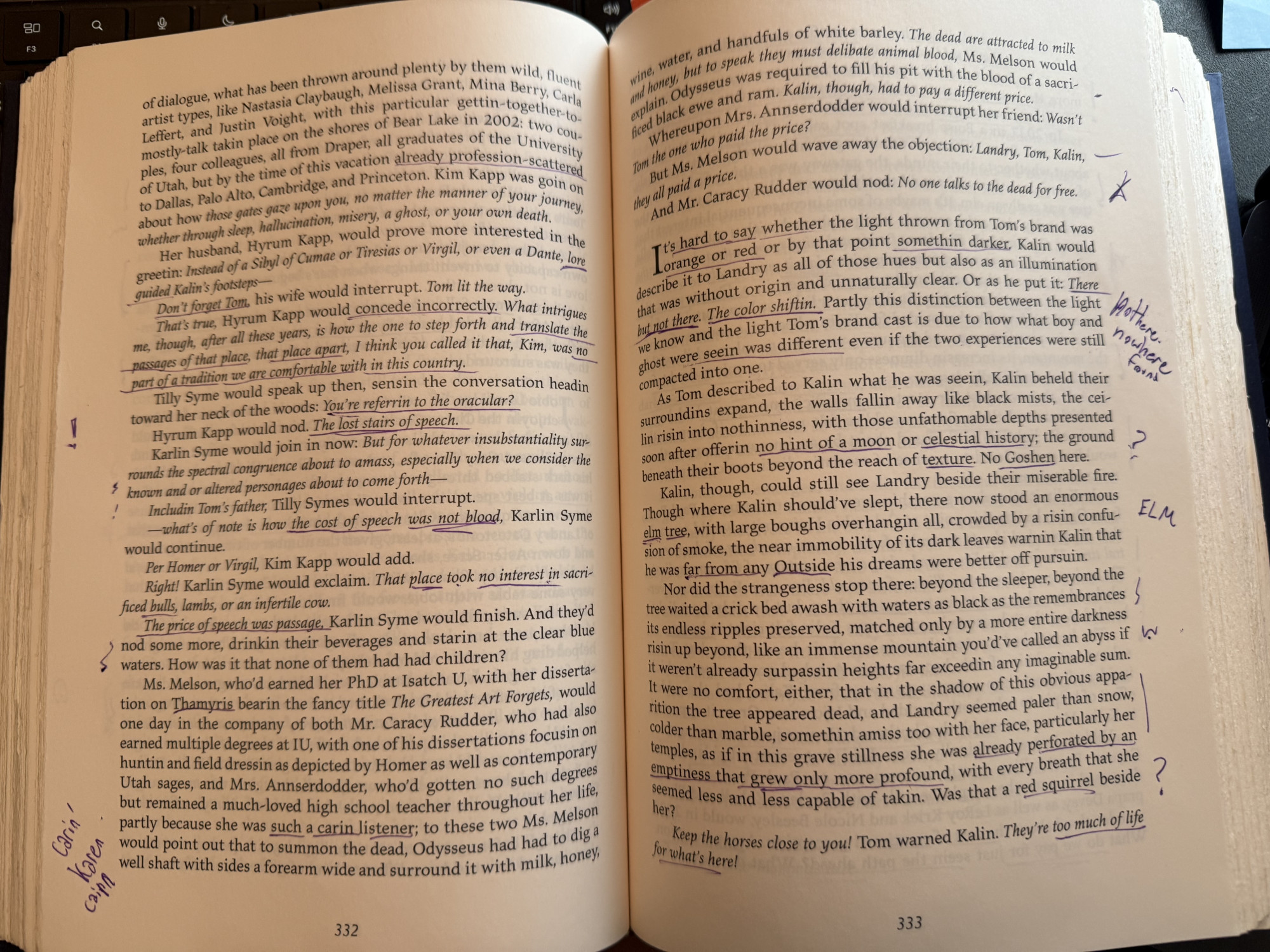
I'll have to get to the other books another time. Hopefully this is a good starting place. Also: I think I recommend Tom's Crossing as a starting place if you aren't as interested in formal fuckery. It just came out, it's gorgeous, and it's a clearly-told story about friendship, murder, and ghosts.
...Oh, and a concordance can also be "the inheritance by two related individuals (especially twins) of the same genetic characteristic, such as susceptibility to a disease." In a book about two people whose fates are entwined.
Okay, have fun!!!